Key Takeaways
- OKRs set goals and define measurable results; KPIs measure ongoing performance.
- Use OKRs to drive focus, alignment and ambitious objectives.
- Use KPIs to track performance and support data-driven decisions.
- OKRs and KPIs can work together to connect strategic goals with performance measurement.
In the world of performance management and goal-setting, two acronyms frequently come up: OKR vs KPI.
While they might seem similar at first glance, OKRs (Objectives and Key Results) and KPIs (Key Performance Indicators) serve distinct purposes and have different methodologies.
Understanding the differences between OKRs and KPIs is crucial for organisations looking to effectively measure and improve their performance.
Whether you’re a team leader, a product manager, or a simply a professional looking to optimise your personal performance, the insights provided in this comprehensive guide will serve as your compass in the complex realm of goal-setting and performance measurement.
Table of contents:
What are OKRs?
What are KPIs?
OKR Examples
KPI Examples
OKR vs KPI: Which one should I use?
KPI & OKR software
FAQs

What are OKRs?
Objectives and Key Results, commonly referred to as OKRs, are a goal-setting and performance management framework that has gained significant popularity in the business world.
Originally conceived by Andy Grove at Intel, OKRs were later popularised by companies like Google.
This approach has since been adopted by organisations of all sizes, from startups to Fortune 500 companies, due to its effectiveness in driving focus, alignment, and measurable results.
Objectives
Objectives in OKRs represent the aspirational and qualitative goals that an organisation, department, or team aims to achieve.
These objectives serve as the North Star, guiding everyone towards a common purpose.
Besides being attainable, objectives should be inspiring, motivating, and provide a clear sense of direction. In essence, they answer the question of “what” needs to be accomplished.
Key Results
Complementing the objectives, Key Results (KRs) are specific, measurable, and time-bound milestones or metrics that indicate progress towards achieving the stated objectives.
They help you measure success by answering the question of “how” exactly progress will be tracked and evaluated.
KRs are designed to be concrete and actionable, making it evident whether the desired outcome has been accomplished.
Why OKRs matter
The beauty of OKRs lies in their simplicity and flexibility: they are typically set for a defined period, often quarterly or annually, and are meant to be reviewed and revised as necessary.
The adaptability of these goal-setting frameworks allows organisations to pivot and adjust their goals in response to changing circumstances, market dynamics, or strategic shifts.
OKRs also encourage transparency and alignment within organisations.
When each team and individual has a clear set of objectives and KRs, it becomes easier to see how their efforts contribute to the overarching goals of the company, hence encouraging a sense of purpose and helping teams prioritise their work effectively.

What are KPIs?
Key Performance Indicators, often abbreviated as KPIs, are a fundamental component of performance measurement and management within organisations.
Unlike Objectives and Key Results (OKRs), which are primarily focused on setting goals and tracking progress toward those goals, KPIs serve a different but equally crucial role in assessing performance and guiding decision-making.
Quantifiable Metrics
KPIs are, by definition, quantitative metrics.
They provide organisations with a way to measure performance objectively, often using numerical values or percentages.
These metrics are chosen strategically to reflect critical aspects of an organisation’s performance.
Performance evaluation
While OKRs are used to set goals and objectives, KPIs are used to evaluate and assess performance against those goals.
KPIs are tied directly to an organisation’s strategic objectives and are used to determine whether those objectives are being met.
In essence, they help answer the question: “How well are we performing?”
Specific to different domains
KPIs can vary widely across industries and functions within an organisation.
For example, sales teams may use KPIs like monthly revenue, conversion rates, and customer acquisition cost, while customer support teams may track KPIs like response time and customer satisfaction scores.
Each department or team may have its own set of KPIs tailored to its specific goals and responsibilities.
Long-term measurement
KPIs are typically used for long-term performance assessment.
They are often tracked continuously or periodically, such as monthly or quarterly, to monitor progress and trends over time.
The historical data gathered from KPI checkins can provide valuable insights into performance patterns and areas that require improvement.
Strategic decision-making
KPIs play a vital role in guiding strategic decision-making.
When organisations track KPIs consistently, they can identify areas of strength and weakness and adjust their strategies accordingly.
For instance, if a KPI related to customer satisfaction shows a declining trend, it can works as a baseline for changes in customer service processes or strategies.
Alignment with organisational goals
KPIs should always align with an organisation’s overall goals and objectives.
They serve as a direct link between strategic intentions and performance outcomes.
When KPIs are well-defined and aligned, they provide a clear path for organisations to monitor progress toward achieving their mission and vision.

OKR examples
To gain a deeper understanding of how Objectives and Key Results (OKRs) work in practice, let’s explore some concrete examples across various business contexts.
These examples will illustrate how organisations use OKRs to set ambitious objectives and measure the progress of their initiatives through key results.
Example 1: Company-wide OKRs
Objective: Achieve Sustainable Growth in the Next Year
Key results:
- Increase annual revenue by 15% compared to the previous year.
- Expand the customer base by acquiring 20,000 new customers.
- Reduce customer churn rate to less than 5%.
- Launch two new product lines within the next six months.
In this scenario, the company’s objective is to achieve sustainable growth. The key results provide specific, measurable targets that indicate whether the company is making progress towards this overarching goal.
Example 2: Departmental OKRs (marketing team)
Objective: Enhance Brand Visibility and Engagement
Key results:
- Increase website traffic by 25% within the quarter.
- Achieve a 10% growth in social media followers.
- Launch two successful influencer marketing campaigns.
- Boost email open rates by 15% in the next three months.
Here, the marketing department has set objectives related to enhancing brand visibility and engagement. The key results are designed to measure various aspects of their performance, such as web traffic, social media growth, and email marketing effectiveness.
Example 3: Team-level OKRs (product development)
Objective: Deliver a High-Quality Software Release
Key results:
- Achieve a 95% code test coverage for the upcoming release.
- Reduce the number of reported software bugs by 20%.
- Deliver all user stories within the sprint timeline for the next three cycles.
- Receive a customer satisfaction rating of 4.5 out of 5 for the new release.
In this case, the product development team’s objective is to deliver a high-quality software release. The key results focus on specific aspects of software development, such as code quality, bug reduction, and meeting project timelines.
Example 4: Individual OKRs (sales representative)
Objective: Exceed Sales Targets for the Quarter
Key results:
- Achieve 120% of the quarterly sales target.
- Secure contracts with three new high-value clients.
- Increase upsell revenue by 10% through existing client relationships.
Here, an individual sales representative has set their objective to exceed quarterly sales targets. The key results specify quantitative targets related to revenue, client acquisition, and upselling.
These examples highlight how OKRs can be customised to suit different levels of an organisation, from company-wide objectives to departmental, team-level, and even individual goals.
OKRs provide a clear structure for setting objectives and measuring progress, promoting alignment and transparency throughout the organisation. They empower individual teams to work collaboratively toward achieving ambitious yet attainable goals.

KPI examples
To gain a comprehensive understanding of Key Performance Indicators (KPIs) and how they function in various business domains, let’s explore practical examples across different areas.
These examples illustrate how KPIs are used to measure and evaluate performance effectively.
Sales KPIs:
- Monthly sales revenue:
- KPI: To track the total revenue generated each month.
- Measurement: Monthly revenue in dollars.
- Purpose: This KPI provides a clear picture of sales performance, helping organisations assess their revenue generation.
- Sales conversion rate:
-
- KPI: To measure the percentage of qualified leads that convert into paying customers.
- Measurement: Conversion rate (%) = (Number of customers acquired / Number of leads) * 100.
- Purpose: Conversion rate KPI helps sales teams gauge the efficiency of their sales processes and the quality of leads.
- Customer acquisition cost (CAC):
-
- KPI: To assess the cost of acquiring each new customer.
- Measurement: CAC = Total Sales and Marketing Expenses / Number of New Customers Acquired.
- Purpose: CAC KPI helps organisations evaluate the efficiency of their customer acquisition efforts and optimise their marketing spend.
Employee performance KPIs:
- Employee satisfaction score:
- KPI: To gauge employee happiness and engagement.
- Measurement: Employee satisfaction scores from regular surveys.
- Purpose: This KPI helps HR departments monitor employee morale and identify areas for improvement.
- Average time to fill a job vacancy:
-
- KPI: To evaluate recruitment efficiency.
- Measurement: The average number of days it takes to fill a job vacancy.
- Purpose: Tracking this KPI helps HR teams streamline their hiring processes.
- Employee turnover rate:
-
- KPI: To monitor employee retention.
- Measurement: Employee turnover rate (%) = (Number of Employees Who Left / Average Number of Employees) * 100.
- Purpose: This KPI helps organisations understand employee retention challenges and develop strategies to retain talent.
Marketing KPIs:
- Customer lifetime value (CLV):
- KPI: To estimate the total revenue a business can expect from a customer over their entire relationship.
- Measurement: Average purchase value x Average purchase frequency x Average customer lifespan.
- Purpose: CLV is a crucial KPI for marketing teams as it directly relates to customer retention. It helps organisations understand the long-term value of their customer base and assess strategies for retaining customers over a certain period of time.
- Click-through rate (CTR):
-
- KPI: To measure the effectiveness of online advertising campaigns.
- Measurement: CTR (%) = (Number of Clicks / Number of Impressions) * 100.
- Purpose: CTR helps evaluate the performance of online ads and the relevance of ad content.
- Return on investment (ROI):
-
- KPI: To assess the profitability of marketing campaigns.
- Measurement: ROI (%) = [(Revenue from Marketing Campaign – Marketing Cost) / Marketing Cost] * 100.
- Purpose: ROI KPI helps marketing departments determine the effectiveness of their investments and optimise their budget allocation.
These examples demonstrate the versatility of KPIs across different business functions.
KPIs are selected based on an organisation’s specific goals and objectives, providing a quantitative framework to assess performance, make data-driven decisions, and continuously improve processes.
Whether it’s in sales, HR, marketing, or any other area, KPIs play a pivotal role in measuring success and driving strategic decisions.

Communicate Risks Effectively – How to Visualise Risks by Project Stage
Learn how to visualise and communicate project risks effectively.
OKRs vs KPIs: Which one should I use?
Deciding between Objectives and Key Results (OKRs) and Key Performance Indicators (KPIs) is a critical choice for organisations seeking to manage and measure their performance effectively.
Each framework has its distinct characteristics and applications, and understanding their differences is essential for aligning them with your organisation’s goals and needs.
When to use OKRs
- Setting aspirational goals: OKRs are ideal when your organisation needs to set aspirational, qualitative objectives that inspire and motivate teams. They focus on the “what” and help define the direction your organisation should take.
- Balancing qualitative and quantitative: OKRs incorporate both qualitative objectives and quantitative key results, striking a balance between vision and measurable progress. This combination helps ensure that teams stay inspired while also tracking outcomes objectively.
- Adaptability and flexibility: OKRs are well-suited for organisations that require adaptability and agility in their goal-setting methods and processes. They are often set for shorter periods (e.g. within the next quarter) and can be adjusted in response to changing circumstances, market shifts, or new opportunities.
- Alignment and inspiration: OKRs are effective at aligning teams and individuals with overarching company objectives. They inspire collaboration and a shared sense of purpose, making them particularly useful for organisations with dynamic and innovative cultures.
- Short to medium-term goals: OKRs are typically associated with short to medium-term objectives, making them suitable for organisations that need to set ambitious goals within specific timeframes.
When to use KPIs
- Quantitative performance measurement: KPIs are the go-to framework for quantifying and assessing performance in specific areas. They provide clear, numerical metrics that answer the question of “how well are we performing?”
- Long-term strategic evaluation: KPIs are often associated with long-term strategic goals and objectives. They are continuously monitored to ensure that performance aligns with strategic objectives, making them valuable for organisations with well-established, long-term, and ambitious goals.
- Stability and consistency: KPIs tend to remain stable over time, offering consistent measurements that are essential for long-term tracking and evaluation.
- Functional areas and departments: KPIs can vary significantly based on the department or team’s function. For example, sales teams may have sales-related KPIs, while HR departments may focus on employee-related KPIs. This way, every department can each have their own set of KPIs tailored to smart goals and specific responsibilities.
- Data-driven decision-making: KPIs are crucial for making data-driven decisions. They help organisations understand their performance in relation to strategic objectives, identify areas that need improvement, and optimise strategies accordingly.

Choosing between OKR vs KPI:
The choice between OKRs and KPIs should align with your organisation’s specific needs and goals:
- Use OKRs when you want to set aspirational, high-level objectives that guide the organisation’s direction. OKRs are effective at fostering adaptability and aligning teams with a shared vision.
- Use KPIs when you need precise, quantitative metrics to evaluate ongoing performance against strategic objectives. KPIs provide the data-driven insights required for continuous improvement and decision-making.
| Ask yourself… | Use OKRs if… | Use KPIs if… |
|---|---|---|
| What are you trying to achieve? | You want to set an ambitious objective and define measurable results. | You want to measure how well an existing area of the business is performing. |
| What timeframe are you working to? | You are setting short- to medium-term goals, such as quarterly objectives. | You need to monitor performance consistently over the long term. |
| How much flexibility do you need? | Your goals may need to adapt to changing priorities, markets or opportunities. | You need stable, consistent measures that can be tracked over time. |
| What do you need from your teams? | You want to create alignment, focus and a shared sense of purpose. | You want clear metrics to evaluate performance within a specific function or department. |
| What type of information do you need? | You need a combination of qualitative objectives and quantitative results. | You need precise, quantitative data to support performance measurement and decision-making. |
| Can you use both? | Yes. OKRs can define the bigger-picture objectives, while KPIs can provide the ongoing metrics used to monitor performance. | |
Using both OKRs and KPIs together:
In many cases, organisations choose to use both OKRs and KPIs in tandem.
OKRs set the big-picture intentions and aspirational objectives, while KPIs provide the day-to-day metrics needed to monitor performance within teams and departments.
This combination allows for a comprehensive approach to performance management, encompassing both high-level goals and specific, quantifiable measurements.
Ultimately, the choice between OKRs and KPIs, or the decision to use both, should be guided by your organisation’s performance management strategy and its specific objectives.
By leveraging the strengths of a KPI or OKR framework, organisations can optimise their approach to achieving both aspirational objectives and measurable results.
KPI & OKR Software
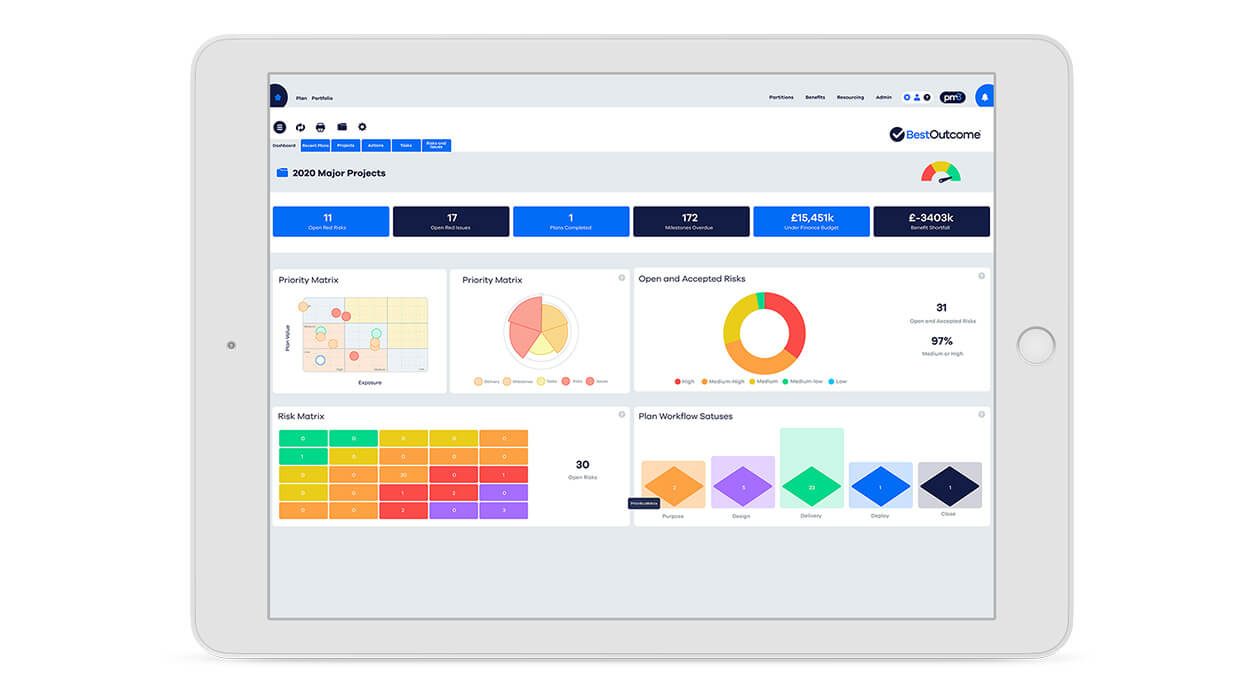
PM3 is an award-winning PPM (Portfolio, Program, and Project Management) tool, designed to help organisations manage projects, transformation programmes and complex portfolios.
PM3 can support organisations of different sizes, whether they are managing a few projects, large transformation programmes or complex portfolios. Its features include resource management, configurable dashboards and tools for team collaboration.
Key features of PM3:
Clarity and simplicity: PM3 uses a decluttered interface that displays the screens and information relevant to each user’s role. This reduces complexity and helps make the software easier to adopt.
Resource management: PM3 allows project managers to request resources and resource managers to allocate them efficiently. This helps organisations ensure they have the right mix and number of resources across their portfolio.
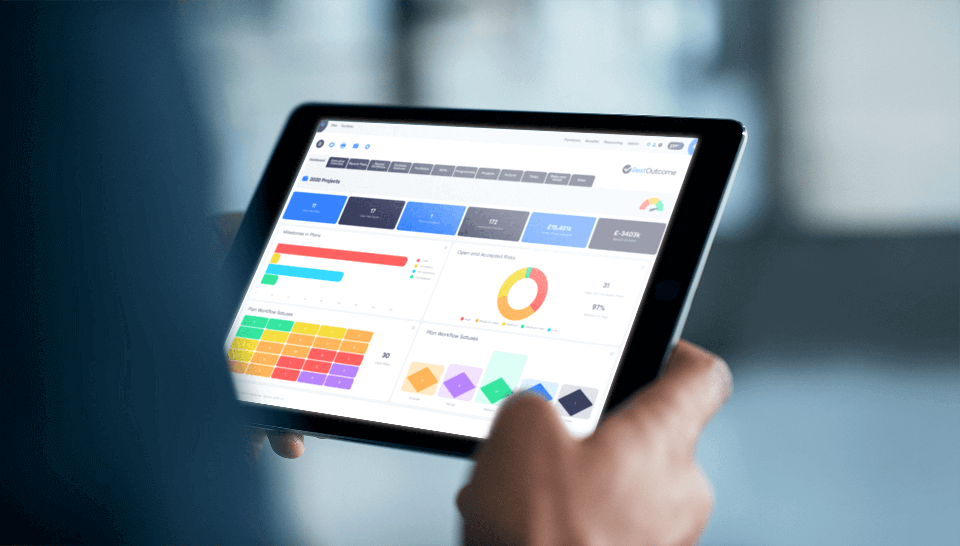
Dashboards: PM3 provides configurable dashboards that can be tailored to different needs. Dashboards can be viewed on screen or printed as reports, making them useful for executives and portfolio managers.
Team collaboration: PM3 supports collaboration within project teams through PM3 itself or the PM3Team app, which is available on Google Play and the App Store. Updates made through the app are synchronised with PM3.
Together, these features provide a central tool for managing projects, programmes and portfolios, while giving different users access to the information and functionality relevant to their role.
For more info about how PM3 can help your organisation set OKRs and KPIS, schedule a demo now or contact us at sales@eleco.com/pm3
FAQs
1. What is the difference between an OKR and a KPI?
OKRs are used to set objectives and measure progress towards achieving them, while KPIs are quantitative metrics used to measure ongoing performance against strategic objectives.
2. What does OKR stand for?
OKR stands for Objectives and Key Results. The Objective defines what you want to achieve, while Key Results provide measurable targets for tracking progress.
3. What does KPI stand for?
KPI stands for Key Performance Indicator. KPIs are quantitative measures used to assess performance and track progress over time.
4. When should I use OKRs?
OKRs are useful when you want to set ambitious goals, align teams around a shared direction, and track measurable progress over a short- to medium-term timeframe.
5. When should I use KPIs?
KPIs are useful when you need to measure ongoing performance using consistent, quantitative metrics. They can be used across different functions, including sales, HR and marketing.
6. Can you use OKRs and KPIs together?
Yes. OKRs can define the bigger-picture objectives an organisation wants to achieve, while KPIs can provide the ongoing metrics used to monitor performance within teams and departments.
7. Are OKRs better than KPIs?
Neither framework is inherently better. OKRs are suited to setting objectives and driving alignment, while KPIs are suited to measuring ongoing performance. Many organisations can benefit from using both together.
