Key Takeaways
PMO maturity improves governance, consistency, and reporting, but it does not automatically lead to better delivery outcomes or business value. High-performing PMOs use maturity as a foundation for stronger decision-making, portfolio visibility, and strategic alignment, ensuring projects deliver measurable impact rather than simply following more structured processes.
PMO maturity is often seen as the benchmark for effective project delivery, but not everyone finds that improving it leads to better outcomes.
Despite investing in frameworks, governance, and standardised processes, senior leaders can still be left asking the same questions: Why are projects underperforming? Where is the real business value?
The reality is that PMO maturity, on its own, is not a guarantee of success. While it provides structure and consistency, it can also create a false sense of progress if it isn’t tied to measurable impact.
This article explores the gap between PMO maturity and real-world delivery performance, helping organisations understand how to move beyond process for process’s sake. By reframing PMO maturity as a capability enabler, not an end goal, you can start focusing on what truly matters: visibility, better decision-making, and tangible business results.
Table of Contents
The PMO Maturity Myth
Why Delivery Still Fails
What PMO Maturity Actually Means
PMO Maturity vs Business Value
Understanding PMO Maturity Models In Context
What High-Performing PMOs Do Differently
Improving PMO Maturity with ROI in Mind
The Role of PPM Tools
Focus on Value, Not Maturity

The PMO Maturity Myth
PMO maturity has long been positioned as a marker of organisational progress.
The logic is compelling.
Establish consistent processes, introduce governance, standardise delivery, and performance should improve as a result.
In practice, the picture is less straightforward.
Many organisations that score highly on PMO maturity models continue to face persistent delivery challenges. Projects overrun. Strategic priorities lack clarity. Leadership teams question the reliability of reporting.
This points to a fundamental issue. PMO maturity is frequently mistaken for performance.
Maturity models are designed to assess capability. They evaluate how consistently projects are managed, how well governance is applied, and how embedded processes are across the organisation. What they do not measure is whether those processes are driving better decisions or delivering tangible business value.
As a result, organisations can invest heavily in improving PMO maturity while seeing limited return.
Efforts focus on refining frameworks, increasing oversight, and expanding reporting. Yet the underlying challenges around prioritisation, visibility, and value realisation remain unresolved.
For senior stakeholders, this creates a disconnect. The PMO appears more advanced on paper, but its contribution to business performance is harder to evidence.
A shift in perspective is needed.
PMO maturity should not be treated as the end goal. It is a means to an end. The real objective is to improve how effectively the organisation delivers against its strategic priorities.
High-performing PMOs recognise this distinction. They focus less on process for its own sake and more on enabling clarity, supporting decision-making, and ensuring that delivery translates into measurable outcomes.
Without that link PMO maturity is an internal metric, not a driver of success.

Why Delivery Still Fails
As we’ve seen, high levels of PMO maturity are often assumed to correlate with strong delivery performance. Yet many organisations continue to encounter the same underlying issues.
Portfolio visibility remains limited, making it difficult to understand what is truly happening across programmes and projects. Priorities are misaligned, with resources spread across initiatives that do not clearly support strategic objectives. Decision-making slows, and leadership teams lack confidence in the data in front of them. Most critically, there is little clarity on whether delivery is generating measurable business value.
What is less often acknowledged is that these challenges can persist because of increasing maturity, not despite it.
As PMOs evolve, they tend to optimise for control. Governance frameworks expand, reporting becomes more comprehensive, and data volumes increase. But more structure does not automatically lead to better decisions.
In many cases, it creates the opposite effect.
Leaders are presented with more information, but less clarity. Reporting captures activity, but not insight. Decision-making becomes slower, not sharper.
This exposes a deeper disconnect. Governance is mistaken for progress. Reporting is mistaken for visibility.
The result is a PMO that is highly mature in form, but limited in function. The distinction is critical: maturity does not equal performance.

What PMO Maturity Actually Means
PMO maturity refers to how consistently and effectively project and portfolio management practices are applied across an organisation. It is typically assessed using maturity models, which provide a structured framework for evaluating processes, governance, and reporting.
As maturity increases, organisations tend to adopt more standardised processes, clearer governance structures, and more consistent reporting. This creates greater control and reduces variability in how projects are delivered.
However, PMO maturity is focused on how work is managed, not whether the right work is being done.
This is where many organisations encounter limitations.
A mature PMO can demonstrate process compliance and delivery discipline, but still struggle to show commercial impact. It may track progress effectively, yet lack the ability to prioritise initiatives based on value or adapt investment decisions in real time.
Maturity models are therefore best seen as diagnostic tools. They assess operational capability, but they do not measure business performance.
Without a clear link to outcomes, PMO maturity risks improving consistency without improving results.

PMO Maturity vs Business Value
For senior stakeholders, PMO maturity is rarely the end goal. What matters is return on investment, alignment to strategy, and confidence that delivery will achieve the intended outcomes.
This is where a gap often emerges.
Mature PMOs are typically effective at tracking activity. They can report on timelines, budgets, milestones, and status with a high degree of consistency. But this visibility is often limited to what is happening, not what it is achieving. The connection between activity, outcomes, and ultimately business value remains unclear.
As a result, leadership teams are left with well-structured reporting but limited insight into impact. They can see progress, but not always whether that progress is meaningful.
This is the shift organisations need to make. From process-led PMOs to value-driven PMOs.
A value-driven PMO focuses less on reporting activity and more on enabling better decisions. It prioritises decision intelligence, ensuring that information is relevant, timely, and tied to strategic outcomes.
It moves the conversation away from outputs, such as completed deliverables, and towards outcomes, such as realised benefits and measurable impact.
In this context, PMO maturity becomes far more powerful when it is aligned to value. Without that alignment, even the most mature PMO risks operating with precision, but without purpose.

Understanding PMO Maturity Models In Context
PMO maturity models are widely used to assess how developed an organisation’s project and portfolio management capabilities are.
They provide structure, consistency, and a way to benchmark progress over time.
However, their value lies in how they are used — not in the score they produce.
The Typical Stages of PMO Maturity
Most PMO maturity models follow a similar progression:
- Reactive – Delivery is inconsistent, with limited structure or oversight
- Defined – Basic processes and standards are introduced
- Integrated – Governance and practices are embedded across the organisation
- Optimised – Continuous improvement and efficiency become a focus
- Strategic – The PMO plays a role in shaping organisational direction
These stages describe how well project management is systemised. They do not, on their own, indicate whether delivery is effective or valuable.
What Maturity Models Actually Measure
Maturity models are designed to evaluate capability. They assess:
- Process consistency
- Governance structures
- Reporting discipline
- Adoption across teams
What they do not measure is impact. They do not capture whether projects are delivering meaningful outcomes, or whether investment decisions are driving value.
This distinction is often overlooked.
A Diagnostic Tool, Not a Performance Metric
Used effectively, PMO maturity models act as diagnostic tools. They help organisations identify capability gaps, highlight inconsistencies, and prioritise areas for improvement.
The risk arises when they are treated as performance metrics.
Progress becomes defined by moving up maturity levels rather than improving delivery outcomes. Teams focus on process adoption, while questions around value, prioritisation, and impact receive less attention.
In this context, maturity models provide useful direction, but only when they are applied with a clear understanding of their limits and a focus on what they cannot measure.

What High-Performing PMOs Do Differently
The distinction between high-maturity and high-performing PMOs is not structural. It is behavioural.
High-performing PMOs use their capability to influence decisions, shape investment, and drive outcomes that matter to the business.
From Delivery Oversight to Strategic Influence
High-performing PMOs move beyond coordinating delivery and take on a more active role in shaping it.
They focus on value realisation, ensuring that expected benefits are clearly defined, tracked, and revisited throughout the lifecycle of an initiative.
This means shifting the conversation from “Was it delivered?” to “Was it worth it?”
They also ensure that portfolios are actively aligned to strategic priorities. This is not a one-off exercise, but an ongoing process of reassessment. As business conditions change, so too should the portfolio.
Speed is another differentiator.
Rather than adding friction, high-performing PMOs enable faster, data-informed decisions. They reduce ambiguity by surfacing the right information at the right time, allowing leaders to act with confidence.
Crucially, they provide real-time visibility. Not just retrospective reporting, but forward-looking insight that highlights risks, trade-offs, and emerging opportunities.
In doing so, the PMO evolves from an administrative function into a strategic partner.

Improving PMO Maturity with ROI in Mind
Improvement efforts are most effective when they are anchored in business outcomes rather than maturity targets.
High-performing PMOs define success in terms of impact. This means establishing clear links between initiatives and the outcomes they are expected to deliver, and using those links to guide prioritisation and investment decisions.
Data plays a central role, but not in volume. The focus is on data quality, relevance, and usability. Information should support decisions, not overwhelm them.
Continuous improvement is also approached differently. Instead of periodic reviews, high-performing PMOs embed feedback loops into day-to-day operations. They test, learn, and adapt in response to real performance.
Finally, they invest in capability in a balanced way. This includes not only PPM tools and frameworks, but also the skills required to interpret data, challenge assumptions, and engage stakeholders at a strategic level.
The emphasis is consistent: measure what matters. Not activity, but outcomes. Not compliance, but impact.
The Role of Technology: PPM Tools
Project portfolio management (PPM) tools are often introduced to bring structure and control to delivery. At a basic level, they centralise data, standardise reporting, and support governance.
But their real value lies elsewhere.
When used effectively, PPM tools enable organisations to move from fragmented information to joined-up decision-making. They provide a clear view across the portfolio, allowing leaders to understand not just what is happening, but what should happen next.
What Effective PPM Tools Enable
- Portfolio visibility – a complete view of projects, programmes, and performance across the organisation
- Scenario planning – the ability to model trade-offs and prioritise initiatives based on changing conditions
- Resource optimisation – balancing demand and capacity to avoid bottlenecks and underutilisation
- Real-time reporting – up-to-date insights that support timely, informed decisions
In this sense, PPM tools play a critical role in bridging the gap between PMO maturity and measurable impact. They turn structured processes into actionable insight.
How PM3 Enables Better Decisions
PM3 is designed with this shift in mind. Rather than simply consolidating project data, it transforms it into a single, reliable source of truth that supports decision-making at every level.
End-to-End Portfolio Visibility
PM3 links strategy, governance, and delivery in one view, giving organisations clarity from initial pipeline through to benefits realisation. This allows leadership teams to prioritise the right work and track progress against objectives with confidence.
Real-Time Insight and Reporting
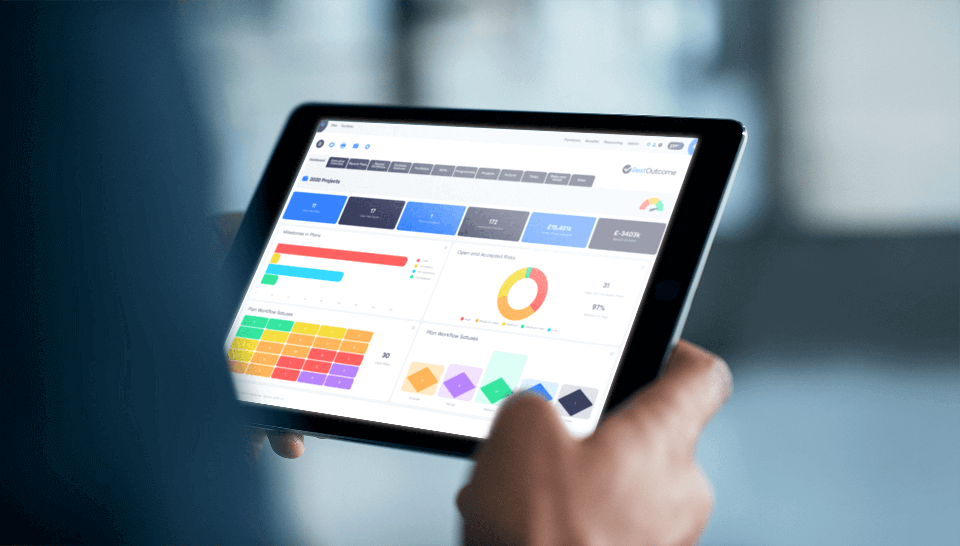
With over 200 configurable reports, real-time dashboards, and direct Power BI integration, PM3 provides immediate visibility of performance, risks, and outcomes. This supports faster, more informed decision-making without relying on manual reporting.
Resource and Capacity Optimisation
PM3 enables organisations to forecast demand, manage capacity, and allocate resources effectively across portfolios. This helps prevent over-allocation, reduce delivery risk, and ensure that critical initiatives are properly supported.
Governance
Built for regulated environments, PM3 offers audit-ready governance, full transparency, and robust reporting capabilities. Boards, auditors, and stakeholders can rely on consistent, accurate data to support oversight and assurance.
Focus on Value, Not Maturity
PMO maturity provides structure, consistency, and control, but it is not, in itself, a measure of success.
Organisations that focus solely on improving maturity risk refining how work is managed without improving what that work delivers.
The shift is straightforward but significant. From process to outcomes. From reporting to insight. From activity to value.
The most effective PMOs use maturity as a foundation, not a destination. They prioritise decisions that align investment with strategy, measure impact in commercial terms, and ensure that delivery translates into tangible results.
Because ultimately, PMO maturity only matters when it drives value.
FAQs
How to assess the maturity of a PMO?
PMO maturity is typically assessed using a PMO maturity model that evaluates process consistency, governance structures, reporting discipline, and how widely project management practices are embedded across the organisation. These assessments help identify capability gaps and areas for improvement.
What are the 5 levels of project maturity?
The five common levels of project maturity are Reactive, Defined, Integrated, Optimised, and Strategic. Each stage reflects increasing levels of standardisation, governance, continuous improvement, and alignment between project delivery and organisational strategy.
What does a mature PMO look like?
A mature PMO has established governance, standardised delivery processes, consistent reporting, and strong portfolio oversight. However, the most effective mature PMOs also focus on value realisation, strategic alignment, and enabling faster, data-driven decision-making.
What is the PMO maturity model?
A PMO maturity model is a framework used to measure how developed an organisation’s project and portfolio management capabilities are. It assesses operational capability and process adoption, helping organisations improve consistency and governance while highlighting areas that need further development.
Main Images: Astrid.IQ
