What is the Last Planner System? A quick guide to construction’s powerful project management methodology
Nobody wants a project to run over time and budget. That’s why building companies invest in new systems and software for planning and managing construction work to meet project goals.
The Last Planner System® is a popular way to run lean construction projects, helping trades to work closer together to solve problems and make progress. It’s a methodology that has become more widely used in recent years, as pressures on construction teams grow.
Here, Elecosoft shares more information on the Last Planner System and how its principles are helping building companies to continuously learn, improve and deliver great results.
Last planning: a lean construction methodology
The Last Planner System is a methodology for planning and managing projects, built on lean construction principles. The concept is built on decades of research by Glenn Ballard and Greg Howell, who wanted to optimise trade coordination and improve construction planning reliability.
Ballard and Howell recognised that limiting work to just tasks that can be completed within a certain time frame stops the frequent context switching that typically happens on construction sites. Adopting a more focused approach increases tradespeople’s productivity and reduces time and material wastage.
Last Planning brings a holistic approach to construction, meaning everyone involved in a project needs to buy into the system to reap the full benefits. By enabling closer collaboration jobs are completed at the right time, and teams work together to find alternative routes when obstacles are encountered.
What are the key stages of last planning?
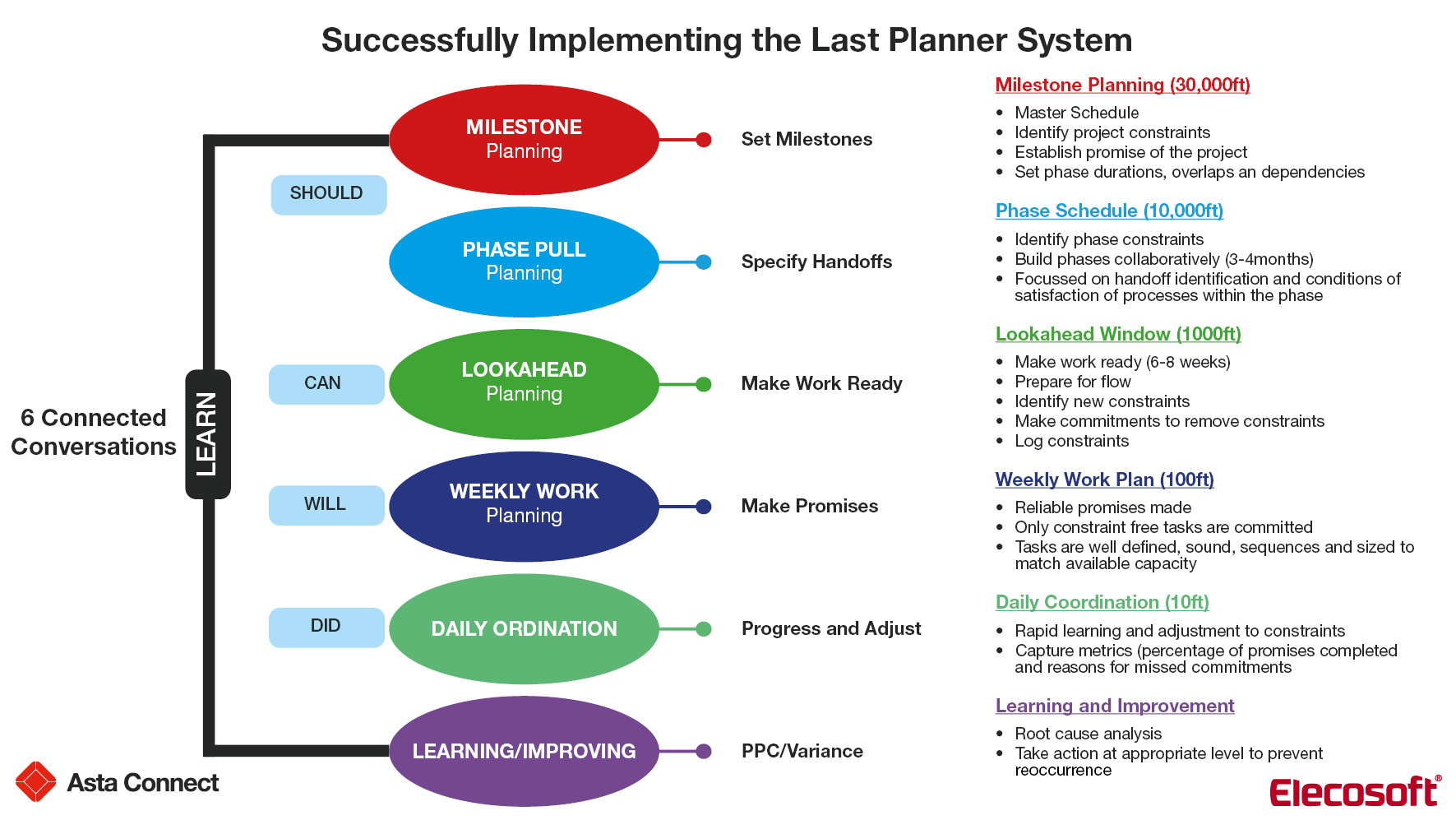
The Last Planner System can be segmented into six phases, all of which are interconnected. To succeed, stakeholder buy-in needs to be secured across all six stages.
Phases 1 and 2: Milestone planning and phase pull
The first objective is to assess the feasibility of the overall project. Allocating time to milestone planning ensures teams have the time to set overall goals and align their success criteria for the project.
The outcome of this stage is to define achievable goals, assign ownership of these goals, establish risk areas and set completion dates for each milestone needed to achieve desired outcomes. Milestone planning creates ‘stakes in the ground’ that project phases and procurement activity dependencies should align with. This is the second stage in the process, known as phase pulling.
The pull plan enables last planners to commit to which works will be completed between each start and finish milestone, and how these works will be achieved. Ideally, the schedule should be completed three months before that phase begins and is often facilitated by a pull planning workshop.
Pull planning allows last planners to sequence jobs and commitments and identify key handoffs between trades to maintain project flow. Planning works backwards from the final requirement that needs to be completed, allowing project teams to determine the optimal pace of work and limit variation to workflow and crew sizes. Any constraints can be managed in a constraints log.
For milestone planning and phase pulling to work, it is crucial that the right disciplines are involved. Stakeholders can impart their knowledge to capture key constraints like materials, resources, RFIs etc. In design, the last planners will typically be architecture and engineering managers. During the construction phase, construction managers, site managers and heads of trade are key participants.
Phases 3, 4 and 5: Lookahead planning, weekly planning and daily coordination
Lookahead planning establishes what work can be done in a given time frame (typically 6-8 weeks) and what needs to happen to ‘make work ready’. This provides an opportunity to identify any constraints that could impact progress – resourcing needs, permits required etc.
During this stage, it’s critical that any actions to remove constraints are assigned to a responsible person. That person should promise to resolve the constraint by a given date.
The lookahead plan also allows project teams to break down tasks into more detail, optimising system flow. These are phases four and five. Work packages are divided into the right sizes for daily and weekly planning management. Jobs are also tagged as critical and non-critical in this phase to ensure workflow does not fall behind schedule.
The weekly work plan and daily coordination help the last planners fulfil their promises. The last planner should state which of their teams’ tasks will be completed each day and progress is discussed during daily huddles. Regular communication creates reliability in tracking performance and allows teams to be agile in their approach to getting jobs done.
Phase 6: Continuous improvement
The final stage in the Last Planner System is continuous improvement.
Throughout each phase, there are opportunities to learn and enhance the next project or phase of the current project. For example, many last planners monitor percent plan complete. This measures the percentage of weekly planned tasks completed or their frequency/variance. Tracking this allows teams to complete a root cause analysis on why the plan didn’t complete as expected.
A learning mindset is critical to success as skills are developed through practice. The combination of a collaborative platform and culture of learning will facilitate a leaner industry and make significant inroads into the macro challenges that the construction industry faces.
Incorporate lean construction into your next project
The Last Planner System is an effective way to run timely, cost-effective projects. To help more building companies run a lean construction model, Elecosoft has developed Asta Connect, a new collaborative task management tool that uses last planning principles.
Asta Connect enables trade contractors, project managers, contract managers, trade and site managers (last planners) to plan projects and coordinate daily and weekly work schedules. By encouraging collaboration and accountability, our software allows building companies to improve workflow, secure buy-in from all stakeholders and complete more projects on time and within budget.
Book your free Asta Connect demo to see how your company can run lean on its next construction project.