Key Takeaways
- Choosing a PPM tool comes down to six things: portfolio visibility, reporting cadence, resource management, governance, integrations and ease of adoption — not just price or feature count.
- Spreadsheets and generic project tools can cover parts of PPM, but neither gives PMOs the portfolio-level reporting, governance and resource visibility a dedicated PPM tool provides.
- The right PPM software should match your sector’s governance needs — audit trails for regulated or public sector organisations, for example — and fit into your existing tech stack rather than create another disconnected system.
The right PPM software and PPM tools help organisations prioritise projects, allocate resources effectively and ensure investments align with strategic business goals.
Project portfolio management (PPM) is a crucial strategy for any business looking to optimise project outcomes and align them with wider goals.
Yet despite its significant benefits, many organisations still don’t fully understand what PPM really involves or how it’s different from regular project or programme management.
This guide addresses that gap by offering a clear introduction to PPM, outlining its advantages, key processes involved and best business practices, including the use of specialised PPM software.
Table of Contents:
What is project portfolio management?
Project vs programme vs project portfolio management
The benefits of project portfolio management
The PPM process — how it works in practice
What’s the role of a PMO?
Basic PPM tools: spreadsheets, templates and tracking aids
How to choose a PPM tool: buyer’s checklist
PPM implementation and training — what to expect
Leveraging PM3
Frequently Asked Questions
What is project portfolio management?
Project portfolio management (PPM) is the process of selecting, prioritising and managing projects to ensure they support an organisation's strategic goals. Rather than focusing on individual projects, PPM helps organisations invest in the work that delivers the greatest business value.
Project portfolio management (PPM) is a strategic approach to selecting, prioritising and managing projects so they support your organisation’s business goals.
According to the Project Management Institute (PMI), PPM focuses on “doing the right projects at the right time” by managing projects as a portfolio of investments.
Unlike project or programme management, which concentrate on delivering work successfully, PPM helps organisations decide which projects should receive investment.
It evaluates initiatives based on strategic alignment, expected value, resource requirements and risk. This enables organisations to focus time and budget on the projects that deliver the greatest business value.
A key part of project portfolio management is knowing when not to continue with a project. As business priorities, budgets, risks or expected benefits change, PPM gives organisations a structured way to pause, re-scope or stop projects that no longer justify further investment.
If you’re new to these concepts, start with our plain-English guide to what PPM actually means before diving into this detailed guide.

Project management vs programme management vs project portfolio management
While often related, project management, programme management and project portfolio management are distinct disciplines.
Understanding their differences and how they complement each other is crucial for effective project governance.
For a deeper breakdown of the delivery-level differences, read our Programme Management vs Project Management guide.
| Project | Programme | Portfolio |
|---|---|---|
| Scope: A single piece of work with defined objectives, deliverables, timeline and budget. | Scope: A group of related projects managed together to deliver wider outcomes and benefits. | Scope: A collection of projects and programmes selected to support strategic business goals. |
| Governance: Led by a project manager and sponsor, with control over scope, cost, time, quality and risk. | Governance: Overseen by a programme manager or board, with focus on dependencies, change and benefits. | Governance: Managed by senior leaders or the PMO to prioritise, pause, continue or stop work. |
| Reporting cadence: Usually reported weekly or at key milestones to track delivery progress and issues. | Reporting cadence: Reported regularly through programme boards, with updates on benefits, risks and interdependencies. | Reporting cadence: Reviewed monthly or quarterly to assess strategic alignment, value, risk and resource capacity. |
| Tooling needs: Project management tools help teams manage tasks, schedules, risks, issues and delivery updates. | Tooling needs: Programme tools support roadmap planning, dependency tracking, benefit management and cross-project coordination. | Tooling needs: PPM software and PPM tools provide portfolio dashboards, prioritisation, resource planning and executive reporting. |
Project management
Project management is primarily focused on the successful delivery of individual projects. It involves the application of knowledge, skills, tools and techniques to project activities to meet the project requirements.
Project management is concerned with managing the scope, cost and time of individual projects, ensuring they are completed on schedule, within budget and to the specified quality standards.
The primary aim is to achieve specific short-term goals set for each project, addressing the immediate needs of the organisation.
Programme management
Programme management goes a step further by managing a group of related projects.
The key objective of programme management is to optimise the management of interdependencies between projects and to achieve outcomes and benefits that are not available from managing projects individually.
Programme managers are responsible for coordinating and directing the constituent projects to ensure that they align with the organisation’s strategic objectives and that the overall programme delivers the intended value.
Programmes are typically more complex and are aimed at driving significant organisational changes and long-term strategic benefits.
Project portfolio management
Project portfolio management (PPM) looks at the big picture, prioritising and managing a collection of projects and programmes to align with the strategic goals of an organisation.
Unlike project and programme management, which are concerned with getting projects right, PPM is focused on doing the right projects at the right time.
PPM involves selecting and managing a portfolio of projects and programmes as a coordinated whole to achieve your strategic objectives. It sits above individual project methodologies like PRINCE2; a PPM tool coordinates across every project, whichever methodology each one follows.
This entails decision-making processes about project/programme selection, prioritisation, resource allocation and (crucially!) termination, ensuring that the portfolio maximises business value for your organisation.
The benefits of project portfolio management
Project portfolio management (PPM) offers numerous benefits that can significantly enhance an organisation’s ability to achieve its strategic goals:
Resource visibility: See demand, capacity and allocation across the portfolio, so teams can spot conflicts before they delay delivery.
Portfolio-level RAG status: Track red, amber and green status across projects to identify risks, blockers and underperforming work earlier. Clear criteria and objective assessments help ensure consistent reporting, while a “Road to Green” plan can support recovery when a project is off track.
Governance reporting cadence: Create a consistent rhythm for portfolio reviews, executive updates and evidence-based decision-making.
Strategic prioritisation: Compare projects against business goals, expected value, risk and resource demand before committing further investment.
Better benefits tracking: Monitor whether projects are still expected to deliver measurable value, not just whether they are on time.
Strategic alignment
PPM ensures that every project undertaken is aligned with the broader strategic goals of the organisation.
This alignment helps ensure that resources are invested in projects that directly contribute to long-term objectives, rather than being dispersed across less impactful projects.
Strategic alignment also aids organisations in remaining focused on their core values and mission during project selection and execution.
Optimised resource management
By providing a comprehensive view of resource allocation across the entire portfolio, PPM allows organisations to balance workloads and maximise resource utilisation.
This prevents resource bottlenecks and ensures that critical projects have the necessary personnel and materials to succeed, thereby reducing idle time and increasing overall productivity.
Resource management is especially important when multiple projects need the same people, skills or specialist roles at the same time. By comparing resource demand against real capacity, PPM helps organisations avoid over-committing teams, pausing projects unnecessarily or relying too heavily on expensive temporary support.
Clear resource visibility can also help teams prioritise their workload when capacity is limited, making it easier to focus effort on the most important work and manage competing demands.
If you’d like to learn more about resource management, see our comprehensive guide, Resource Management for Projects and Programmes.
Improved decision-making
PPM provides frameworks and tools that enhance decision-making capabilities. Project managers can also use structured decision-making models to evaluate options, involve the right stakeholders and make more consistent decisions.
By prioritising projects based on their expected impact and alignment with strategic goals, decision-makers can maximise returns and minimise risks.
This prioritisation also helps in determining which projects should be accelerated, delayed, or terminated.
Risk management
Implementing PPM allows organisations to identify and address project risks at the portfolio level rather than on a project-by-project basis.
This holistic view enables better anticipation of potential issues, facilitates the implementation of effective mitigation strategies and enhances the organisation’s ability to absorb and manage adverse impacts if they materialise.
PPM also helps organisations understand their overall portfolio risk appetite. Some portfolios may tolerate higher risk where the potential value is significant, while others may need a more cautious approach. The role of the PMO is to make those risks visible, comparable and manageable across the full portfolio.
—
For more info about risk management you can read our guide Communicate Risks Effectively – How to Visualise Risks by Project Stage or alternatively, have a look at Project Risk Management Bias; How Impartial Are You?
Enhanced visibility
With tools like dashboards and real-time reporting, PPM offers stakeholders a clear view of project and portfolio health.
This visibility is crucial for monitoring progress, making adjustments and ensuring that projects remain aligned with strategic objectives.
This portfolio-level visibility is particularly valuable for executives, who need more than individual project updates. PPM gives senior stakeholders a joined-up view of delivery performance, risk, resource pressure and expected business value across the whole portfolio.
Enhanced transparency also fosters better communication across departments, and more effective stakeholder management, helping teams keep the right people informed and manage expectations as projects progress.
Forecasting
PPM provides powerful forecasting tools that help predict the outcomes and benefits of projects within the portfolio. Project managers can also use forecasting models to make better decisions under uncertainty, with different approaches suited to different levels of data availability and complexity.
This foresight is essential for future planning and for anticipating the needs of the organisation in terms of finance, resources and time.
Accurate forecasting aids in setting realistic goals and expectations, which can significantly influence strategic planning and decision-making.
Workflow management
Effective workflow management through PPM ensures that processes across projects are streamlined and efficient.
By standardising work management, organisations can reduce complexity, minimise errors and speed up project execution.
This standardisation also helps maintain quality control throughout the lifecycle of all projects and programmes within the portfolio.
Change management
PPM facilitates effective change management by providing a structured approach to handling change requests and modifications.
This structure ensures that changes are assessed and implemented in a way that minimises disruption and aligns with the organisation’s strategic objectives.
At portfolio level, change management also means understanding how much change different teams, departments or customer groups can absorb at once. Change impact heat maps can help PMOs identify where too many initiatives are landing at the same time, allowing leaders to adjust timelines and reduce disruption.
Effective change management within PPM also aids in maintaining project scope, timelines and budgets, despite changing conditions.
Project planning
PPM enhances project planning by integrating it with strategic objectives and available resources.
Comprehensive project planning within a portfolio context allows for better synchronisation of projects, optimised scheduling and improved stakeholder communication.
This integration ensures that projects are not only planned based on their individual merits but also how they fit within the larger organisational goals.
For a deeper look at the practical advantages, read our blog on the 7 benefits of using PPM tools.

Strategy Execution: The Real Reason It Breaks Down in Organisations
Learn why strategy execution fails and how a strategic PMO helps reduce drift, improve governance, and turn ambition into delivery.

The PPM process — how it works in practice
Portfolio management is the process of reviewing all current and proposed projects together, then deciding where time, budget and resources should be focused.
A clear PPM process helps PMOs move from reactive project tracking to structured portfolio control. In practice, this usually follows five steps.
1. Intake
Project intake is where new project ideas, requests and business cases are captured in a consistent way. Each proposal should include the expected benefits, strategic fit, resource needs, risks, cost and likely delivery timescale.
How a PPM tool supports this: A PPM tool gives PMOs one place to capture new requests, standardise business case information and compare proposals before they enter the portfolio.
2. Prioritisation
Prioritisation helps organisations decide which projects should start, continue, pause or stop. Instead of approving work based on urgency or stakeholder pressure, projects are compared against agreed criteria such as value, risk, strategic alignment and available capacity.
How a PPM tool supports this: A PPM tool can support scoring models, prioritisation dashboards and approval workflows, helping PMOs make decisions using consistent portfolio data.
3. Resourcing
Once projects are prioritised, the PMO needs to check whether the organisation has the people, skills and capacity to deliver them. This prevents teams from committing to more work than they can realistically support.
How a PPM tool supports this: A PPM tool helps show resource demand, capacity, allocation and future pinch points across projects and programmes. For more detail, read our guide to resource management for projects and programmes.
4. Reporting
Reporting gives PMOs and senior leaders a clear view of portfolio health. This should include progress, risks, issues, dependencies, benefits, resource pressure and RAG status at portfolio level.
How a PPM tool supports this: A PPM tool can create dashboards and reports that support a regular governance reporting cadence, from project updates to executive portfolio reviews. To improve consistency, read our guide to project RAG status meanings and best practices.
5. Review
Portfolio review is where leaders check whether active projects still support strategic goals and business value. A structured project evaluation can help assess performance, benefits, risks and other evidence when deciding whether a project should continue, change direction or stop. Projects may need to be accelerated, delayed, re-scoped or stopped as priorities, risks and resources change.
How a PPM tool supports this: A PPM tool helps PMOs track performance over time, monitor benefits realisation and provide evidence for stage-gate reviews and portfolio decisions.
Project RAG Status Meanings and Best Practices
Learn what RAG status means in project reporting, how to define clear criteria, and best practices for using red, amber, and green status to manage project performance.
What’s the role of a PMO?
The project management office (PMO) plays a critical role in supporting project portfolio management.
It acts as the central hub for project and programme oversight within an organisation and ensures that project management standards are consistently applied across the portfolio.
The PMO’s responsibilities include:
Governance: Establishing structured governance frameworks to guide project selection and prioritisation, ensuring alignment with strategic objectives.
Standardisation: Developing and enforcing standard project management practices, methodologies and processes to ensure consistency and quality across all projects.
Resource management: Managing resource allocation efficiently to balance workloads and maximise utilisation of available resources.
Performance monitoring: Tracking and analysing project and portfolio performance metrics using dashboards and other reporting tools to assess performance and ensure projects deliver the expected business value.
Knowledge management: Facilitating communication across project teams and maintaining documentation of lessons learned and best practices.
If you’re interested in learning more about the role of the PMO check out The rise of the project management office, and 6 steps to set your PMO office up for success.

PPM for Regulated Institutions: Governance, Audit Readiness, and Risk Control
Discover practical strategies for improving oversight and audit readiness.
Basic PPM tools: spreadsheets, templates and tracking aids
In project portfolio management, the tools used can significantly impact the effectiveness and efficiency of the entire process.
While specialised PPM software offers comprehensive automation and centralised management solutions, some generic tools can also support PPM activities, albeit partially.
Here is an overview of some of the best project portfolio management tools organised by their primary function:
Project scheduling and tracking
Gantt Charts: These are crucial for visualising project timelines, dependencies and progress. Gantt charts help PMOs manage project schedules effectively and allocate resources accordingly.
Excel: Often the starting point for many PMOs, Excel is used for tracking projects, resources and timelines due to its flexibility and accessibility. However, as project portfolios grow, the limitations of Excel, such as lack of real-time updates and risk of manual errors, become apparent.
Resource management
Timesheets: These tools are fundamental for tracking the time spent by team members on various tasks across different projects. Timesheets help in assessing productivity, optimising resource allocation and planning workforce requirements.
Decision-making
Decision logs: These tools help document and track decisions made throughout the project lifecycle.
Keeping a decision log aids in transparency and accountability, providing a historical record that can be referenced to understand the reasoning behind certain choices and facilitate learning for future projects.
Time management
Time management tools: This category includes a variety of tools aimed at optimising how time is allocated and used across projects.
Examples include time tracking software that ensures accurate recording of time spent on project tasks, and time management books that offer strategies and philosophies to improve overall time utilisation.
Strategic planning
Business portfolio: Often used in strategic business planning, a business portfolio tool helps organisations manage their mix of business units and product lines like a portfolio of investments.
This approach aligns closely with PPM by treating projects and programmes similarly, ensuring strategic alignment and resource allocation across the company’s broader goals.
Workflow optimisation
Checklists and templates: Standardising project management processes through the use of checklists and templates ensures consistency and helps cover essential steps and stages across projects, reducing the likelihood of omissions and errors.
Risk management
Risk management tools: These may include simple spreadsheets or more sophisticated software that helps identify, assess and monitor risks. Effective risk management is crucial for proactive mitigation and maintaining the overall health of the project portfolio.
While these tools are helpful for managing various aspects of PPM, they often fall short of providing the integrated overview required to fully align projects with strategic objectives. Understanding why you need a PPM tool becomes particularly important as portfolios grow and managing projects through separate tools becomes more complex.
For a PMO to truly excel in PPM, using a dedicated PPM software tool that offers comprehensive capabilities, such as strategic alignment, real-time dashboards and advanced analytics, is advisable.
How to choose a PPM tool: buyer’s checklist
Choosing the right PPM tool is not just a software decision. For PMOs, it is a governance, reporting and delivery decision that affects how projects are prioritised, monitored and measured across the portfolio.
Use this checklist to compare PPM tools objectively and understand whether they can support the way your organisation actually manages projects, programmes and portfolios.
| Spreadsheets | Generic project management tools | Dedicated PPM software |
|---|---|---|
| Best for: Early-stage tracking, simple lists and small numbers of projects. | Best for: Managing tasks, schedules and collaboration within individual projects. | Best for: Managing portfolios, programmes, governance, resources, benefits and strategic alignment. |
| Portfolio visibility: Limited, because data is often split across files, versions and teams. | Portfolio visibility: Useful for delivery teams, but often weaker at executive portfolio views. | Portfolio visibility: Gives PMOs and senior leaders a joined-up view of all projects and programmes. |
| Reporting: Usually manual, time-consuming and vulnerable to inconsistent updates. | Reporting: Good for project-level progress, but may need extra work for portfolio reporting. | Reporting: Supports dashboards, governance packs, portfolio RAG status and executive reporting cadence. |
| Resource management: Difficult to manage accurately across multiple projects and teams. | Resource management: Can help with team workload, but may not show portfolio-wide demand and capacity. | Resource management: Helps PMOs track resource visibility, capacity, allocation and future pinch points. |
| Governance: Relies heavily on manual processes, meetings and offline decision records. | Governance: Supports project delivery, but may not provide full portfolio assurance or audit trails. | Governance: Supports portfolio reviews, stage gates, audit trails, prioritisation and benefits tracking. |
| Limitations: Version control, manual reporting and poor scalability as the portfolio grows. | Limitations: Often focused on delivery execution rather than portfolio-level value and governance. | Limitations: Requires clear ownership, adoption planning and consistent PMO processes to deliver full value. |
PM3 is one example of a dedicated PPM tool designed to support this kind of outcome-driven portfolio, programme and project management. It brings together dashboards, reporting, resource management, benefits realisation, prioritisation and portfolio alignment in a configurable platform that can support agile, waterfall or hybrid ways of working.
Unlike building your own process across spreadsheets or disconnected tools, PM3 is designed to provide clarity across the portfolio while keeping the experience simple for users. Its focus is on helping teams manage complexity, improve visibility and stay aligned with the strategic outcomes the organisation needs to deliver.
If you are ready to move from manual portfolio tracking to a dedicated PPM software solution, explore PM3 project portfolio management software.
Portfolio visibility and prioritisation
A good PPM tool should give senior leaders a clear view of every project and programme in the portfolio. It should help the PMO compare initiatives by strategic fit, expected value, risk, cost and resource demand.
As a worked example, PM3 brings project, programme and portfolio information into one view, helping teams connect strategy, governance, delivery and benefits realisation.
Reporting dashboards and governance cadence
PMOs need more than occasional project updates. Look for reporting dashboards that support a regular governance reporting cadence, such as weekly project reviews, monthly portfolio boards and executive updates.
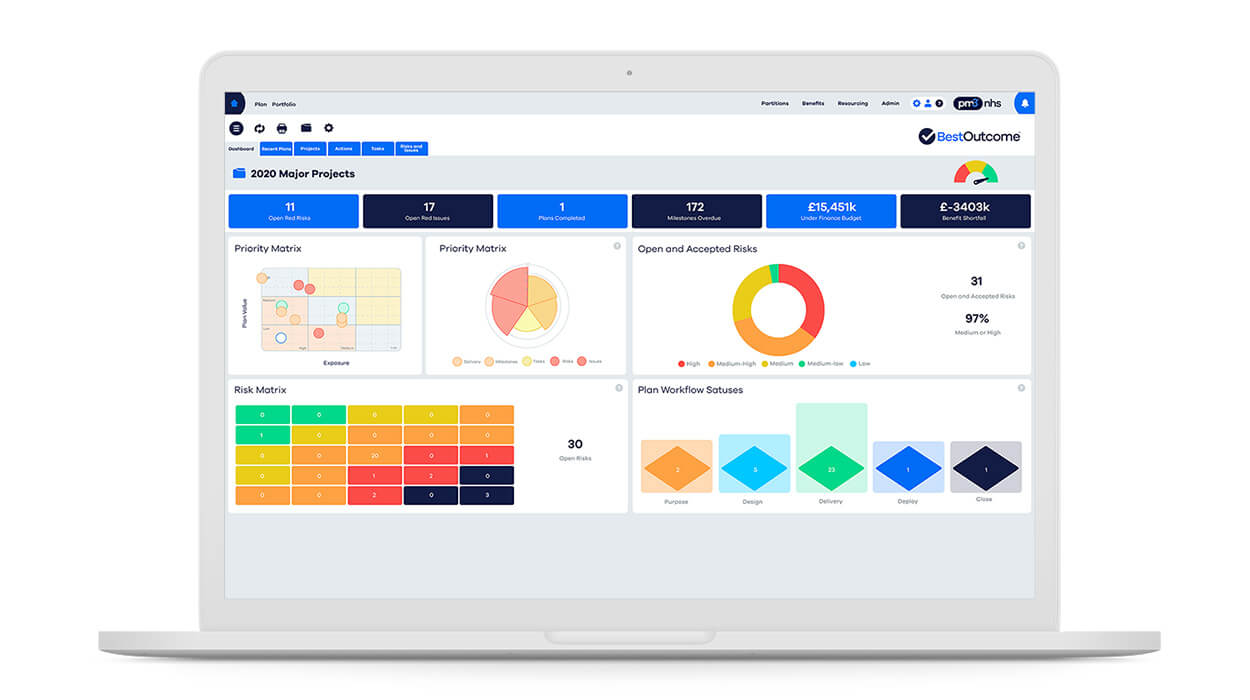
PM3 includes configurable reports, dashboards and automated reporting options, helping organisations reduce manual reporting and give stakeholders a consistent view of portfolio performance.
RAG status at portfolio level
A PPM tool should make it easy to see red, amber and green status across the whole portfolio, not just within individual project plans. This helps PMOs identify underperforming projects, delivery risks and emerging blockers earlier.
With PM3 as the example, portfolio dashboards and drill-down reporting can be used to surface RAG status, risks, issues, milestones and benefits in a format suitable for governance meetings.
Resource visibility and capacity planning
Resource visibility is one of the most important reasons to move from spreadsheets to dedicated PPM software. The tool should show demand, capacity, allocation and future pinch points across teams, roles and projects.
PM3 supports resource and capacity management, helping PMOs forecast demand, prevent over-allocation and understand whether planned portfolios are realistically resourced.
Integration with existing systems
A PPM tool should fit into your existing technology stack rather than creating another disconnected data source. Check whether it can integrate with reporting, finance, collaboration and planning tools already used by your organisation.
PM3 supports integrations with tools such as Power BI, Microsoft Project, Microsoft Teams and SharePoint, helping PMOs connect portfolio data with wider reporting and collaboration workflows.
Sector fit and governance requirements
Different sectors have different governance needs. NHS organisations, local authorities and public sector PMOs often need audit trails, assurance reporting, secure access, benefits tracking and evidence for board-level scrutiny.
PM3 is positioned for regulated and public sector environments, with features such as audit-ready governance, public sector reporting, UK hosting, secure access controls and NHS-focused implementation experience.
Ease of adoption and vendor support model
The best PPM tools are not just feature-rich; they are usable. Before selecting a tool, ask how quickly teams can adopt it, what training is available and how the vendor supports implementation after purchase.
PM3 is designed with configurable screens, role-focused dashboards, training support and built-in learning resources, helping organisations embed the tool into day-to-day PMO practice rather than treating it as a one-off software rollout.
PPM implementation and training — what to expect
Successful PPM implementation is not just about switching on a new tool. It usually involves reviewing your current governance process, agreeing reporting standards, configuring workflows and helping teams understand how the new approach supports better portfolio decisions.
PPM training should be role-based. Project managers may need guidance on updating plans, risks, issues and milestones, while PMO teams need training on dashboards, reporting cadence, resource visibility and portfolio-level governance. Senior stakeholders may also need a clear view of how to interpret reports and use portfolio data in decision-making.
With PM3, this implementation journey is supported through PM3 Pathway, which provides a structured route from onboarding to long-term adoption. Ongoing learning is supported through PM3Learn, giving users access to training resources, templates and practical guidance.
The aim is to make PPM part of everyday working practice, not a one-off software rollout.
Leveraging PM3 for PPM success
Generic tools can be useful for certain aspects of project portfolio management, but they often fall short of providing the integrated, comprehensive capabilities necessary for aligning projects with strategic business objectives.
This is where our PPM tool PM3 comes into play.
An award-winning project portfolio management (PPM) tool, PM3 is renowned for bringing clarity from complexity and is specifically designed to focus on project and programme outcomes.
This makes PM3 ideal whether you’re running a few projects, large transformation programmes, or managing a complex portfolio.
Simplicity and customisation
One of PM3’s standout features is its decluttered interface, which displays only the necessary screens and information each user needs to perform their role effectively.
This streamlined approach not only reduces complexity but also significantly enhances user adoption.
Furthermore, PM3 is highly configurable, allowing it to be tailored to match your organisation’s specific processes.
Training and support
When you choose PM3 you get to partner with our team of dedicated PPM specialists.
Beyond just providing a tool, we offer expert training and mentoring, ensuring that users are not only well trained but also enthusiastic about maximising the tool’s potential.
Additionally, PM3 includes a learning portal with a wealth of resources, including ‘how-to’ videos, processes and templates, all designed to enhance project management skills.
Advanced reporting and dashboards
PM3 boasts over 100 out-of-the-box reports and customisable, drill-down dashboards.
These dashboards are meticulously designed for both on-screen use and print, making them a valuable resource for executives and portfolio managers who need to make informed decisions quickly.
Comprehensive resource management
Effective resource management is crucial in PPM, and PM3 excels in this area.
It offers detailed insights into resource allocation, helping to identify and manage resource ‘pinch points’.
The tool ensures that your planned portfolios are well-resourced, balancing workload across your teams efficiently.
Whether in graphical or tabular form, PM3 enables resource managers to see at a glance whether resources are overloaded or underutilised.
Agility and methodology flexibility
PM3 supports both traditional Waterfall (such as Prince2™) and Agile methodologies, including features like user stories, sprints and kanban boards.
This flexibility ensures that PM3 can adapt to various project management styles, making it suitable for a wide range of industries and project types.
Enhanced team collaboration
The tool promotes effective collaboration across dispersed project teams.
PM3 integrates seamlessly with the PM3Team app, available on both Google Play and the App Store.
Updates on the app are automatically synchronised with PM3, enhancing team productivity and ensuring that everyone is aligned on project goals and progress.
Benefits realisation and prioritisation
PM3 ensures that your benefits realisation plans are both realistic and timely, aligning closely with strategic objectives.
Additionally, its robust prioritisation and transformation capabilities ensure that the most critical projects receive the attention and resources they need to succeed.
Frequently Asked Questions
What does PPM stand for in project management?
PPM stands for project portfolio management. It is the process of managing projects and programmes together so they support strategic goals.
What is the difference between PPM and project management?
Project management focuses on delivering individual projects. PPM focuses on choosing, prioritising and managing the right projects across the whole portfolio.
What does a PPM tool do?
A PPM tool helps PMOs manage portfolio visibility, project prioritisation, resource planning, reporting, risks, benefits and governance in one place.
What does a PMO do?
A project management office (PMO) provides governance, standardisation and oversight across projects and programmes. It helps organisations improve project delivery through resource management, performance monitoring, reporting and the implementation of consistent project management processes.
How do I choose a PPM tool for my organisation?
Choose a PPM tool that supports your reporting needs, resource management, integrations, governance process, sector requirements and user adoption.
Is PPM only for large organisations?
No. PPM is useful for any organisation managing multiple projects, limited resources or competing priorities, especially where strategic alignment matters.
What does PMO stand for?
PMO stands for Project Management Office. It is a central function within an organisation responsible for supporting and overseeing project, programme and portfolio management activities.
What are the 4 types of PMO?
The four common types of PMO are supportive, controlling, directive and enterprise PMO. Supportive PMOs provide guidance and templates, controlling PMOs enforce standards, directive PMOs directly manage projects, and enterprise PMOs oversee strategic alignment across the organisation.
What are the three pillars of PMO?
The three pillars of a PMO are governance, resource management and performance management. Together, these pillars help organisations maintain strategic alignment, optimise resource allocation and ensure projects deliver measurable business value.
